

 myFrasersProperty
 13 38 38


Live proud podcast Ep.3: Neighbourhood first
Choosing community first: how the five‑minute rule shaped Rashi and Div’s home and investment journey.



Listen on
Transcript
Show notes
Full transcript
- Neighbourhood first approach: Rashi and Div chose their community in Mambourin, Victoria before selecting land or a builder, using the “five‑minute rule” (schools, shops, parks, errands within 5 minutes).
- Community trust Visible delivery of amenities and strong ties with local teams built confidence to reinvest in the same area.
- Smart investing: Rewards programs, location value, and infrastructure made Mambourin attractive for both home ownership and investment.
- Builder selection: Reputation, flexibility, and proven delivery were critical; structural upgrades (ceilings, bathrooms, windows) were prioritised early.
- Lifestyle priorities: A big backyard for family, cricket, and outdoor living was non‑negotiable.
- Finance tips: Start saving early, secure pre‑approval, plan for buffers, and align goals with your partner.
- Community connection: Running a café and participating in local events strengthened ties, making Mambourin feel like a tight‑knit neighbourhood.
- Advice for buyers: Be brave, plan savings, know your goals, and trust reputable developers.
Brent: Welcome to the Live proud podcast: candid conversations, real stories and clear advice for Australian home buyers. I'm Brent Hill. Today we're flipping the order most people follow. Instead of 'find a house then hope the area fits,' we'll start with place. You'll meet with Rash and Div, who stress-tested their future neighbourhood with a simple five-minute rule - schools, shops, parks and daily errands within five minutes of home - and only then chose land and a builder. We're talking through how visible delivery and meeting the on-ground team built enough trust to buy again in the same community, this time as an investment. Plus, the practical decisions that kept surprises at bay, titled versus off-the-plan, how to pick a lot that holds value, and where to spend once, so you don't pay twice. Rashi and Divyang, welcome to the podcast.
Divyang: Thanks for inviting us. Thanks for having us.
Brent: Congratulations. Twins! Twin boys. You've got new additions to the family now, which is terrific, and it's a really interesting segue, now that you've got a growing family, to talk about where you live and the journey that you've been on. Rashi, I'll start with yourself. When you were looking to purchase your first property, you looked at the place first, you looked at the neighbourhood first. If you could explain to me a bit about that and some of the key characteristics that you were looking for.
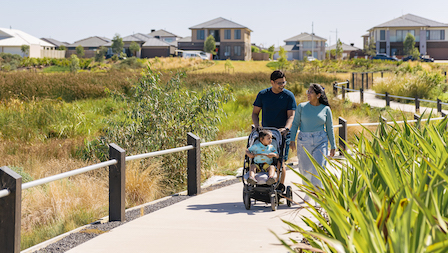
Rashi: So when we were on the lookout for buying a first home, what was important to me was like, I wanted my house close to a park. I wanted the house close to schools and a growing community where I could raise my family. I always knew that I wanted a big family. Didn't know that I was going to get twins, so that was a big surprise to us, but the neighbourhood, I always wanted my kids to know and learn about the culture as well. So when we were on the lookout for our first house, we came across Mambourin. And we used to operate over there, and we could see the project coming to life. And we thought that this would be the perfect place to build a house. Since it was just a five-minute drive to the school. We knew that the school was coming up. There was this fabulous club that was coming up. We had a cafe over there. There was a district park that was like a bonus point, and in the plans, there was a mall as well. So we thought that this would be the ideal place to build our home.
Brent: Yeah, you capture a few key points there. And it's around amenity, around parks, around school and education, around transport, around retail and convenience. I think they're all the key hallmarks when looking at a selection criteria, and it's something which obviously really resonated with yourselves. Is that similar to your upbringing, Rashi, that you knew your neighbours and your community, and that's what you wanted to instill and have with your own family?
Rashi: We had a few friends staying in Mambourin as well, so that was one of our deciding factors, also, to build a house in Mambourin, and everything was at a walking distance. And like, I don't know, we used to stay in Tarneit previously, and we just thought it was overcrowded and overpopulated and Mambourin, since it was a new and growing suburb, we felt the right place to build our home and start our family over there.
Brent: So it was about the density as well. You wanted to make sure that it felt not too overwhelming with the amount of homes and the amount of people, that you had a community there that had similar alignment to you, with growing a family, going to school together, raising families together, enjoying the parks, meeting them in the shops, which is lovely. You not only bought one property, being your home there, but naturally you've gone out and bought an investment property. Was it the same buying process that you went through? Are they the same attributes that you're looking for? An investment property is quite different to a home.
Rashi: Absolutely, so when we first bought with Frasers in Mambourin, we knew that there was a rewards program. So when we bought a second one, we knew about the rewards program, and we were quite attracted to the discount that we were going to get. And we used to stay in the north previously, and then in Tarneit so, you know, we have had a feel of the suburbs that we used to stay. And when we came to Mambourin, since everything is at a walking distance, we thought that if we have a second investment property over there, it would give us a really good value in the future. So that was also one of our reasons to buy our investment property in Mambourin.
Brent: Yeah, brilliant. I think that, again, they're all hallmarks of smart investing - is to be around amenity, to be around infrastructure. The five minute community is becoming more and more popular, and that's what we're looking to develop at Frasers Property - is that sense that you do not have to be car dependent, that you can have a walk, a stroll, a bike ride to shops, schools, entertainment, lifestyle benefits, and that's really resonating with not only investors and renters, but also, more importantly, as owner occupiers and homeowners. But you're also business owners at Mambourin, and also Tarneit, and it feels like you've got the triple there, you've got a home, you've got investment property, but also you've got a business. How does the community embrace you and your family as being a key part of the Mambourin community in the southwest of Melbourne? I think you're the heartbeat of the community, given that you have homes there, raising children there, but also as a village, you know you're seeing everyone come into your cafe every morning and afternoon.
Rashi: Absolutely, I feel that we are not just running a cafe. The community, like, the customers that we get every morning, we've kind of developed a relationship with them as well. I'll just give you an example, when we do community events - last year, we had this Holi event, and the weather was just terrible, but the community showed up. Like, you know, they knew that we are organising this event, and it's for the community. They showed up. They supported us. And it's not just the Holi event, it's like, I feel Mambourin is such a diverse community, and we get to celebrate so many festivals and events, and just by meeting the customers at the cafe, we feel like, you know, it's like a small-knit family now, it's like a small-knit neighbourhood - a community that's been developed now.
Brent: I love that Rashi, and to Div, you're working in that community. It is not necessarily about the built form outcomes that make a community. It's the people. And if you can explain to me - and you did it very eloquently, Rashi - but what does the community mean to you, Div, and how does it make you feel when you see the smiling faces and the support you get in the community?
Divyang: It does really feel uplifting to see people happy and come to the cafe, go to the gym, even just to nod while they're out and about walking. You know that they feel happy just to be around the cafe, the community, and they come and say hello. So, it really helps each and every one of us to grow. They've got something to lean on to. And even with Covid, and just after, we had a lot of customers who used to come into the cafe, maybe trying to work from home, and they try and work from the cafe. So, it really built their connection and the network with everyone, and started to know the community a lot better.
Brent: Yeah, I think you really hit the nail on the head there. It's the sum of the people, and it's the support and the connections that you have with the people around you - that's why it became the place first, before it was the home. And I just wanted to, again, get into that, when you're looking to purchase or go with a builder and purchase a property, Div, what were the key criteria that you looked at when going to and appointing a builder to build your home?
Divyang: We did really go for someone who was more flexible in terms of the house that we wanted to build, and we had seen the work in the past, in terms of the houses they built.
Brent: So, reputation is really important?
Divyang: Yes, we wanted to see and make sure that there is background and there is history in terms of the projects that are getting delivered.
Brent: Really good track record.
Divyang: Yes, absolutely. And that helped trying to understand which builder we were going to pick. There's a lot out there, but you want to try and understand that the house that you want is the same house that the builder is going to deliver for you.
Brent: So, if we can touch on that, there are a lot of display homes that you can go through. And quite often you'll go through them and then sit down and say, I like that house there, but they'll say that they're all upgrades in those homes. So how do you unpack that? Just go well, this is what is important for us, and this is what we want as an upgrade? As opposed to a standard finish?
Divyang: I would say a lot of structural upgrades, you would want to do them straight up, because it may cost you a lot later, or you may not even be able to do it. Just say, for example, you want high ceilings, like you can't change it later. Or if you want bigger windows, so you try and understand to get all the structural changes done first, and any cosmetic changes or upgrades can be done at a later stage when your family grows or as you require. But you cannot add another bathroom or another ensuite after a few years, because it's just not possible, so better to do it in the beginning.
Brent: Yeah, and I think with yourselves, you know, growing family, not expecting twins, so all of a sudden, the three bedroom home, you need four or five bedrooms. So I think it's understanding where you're going in the future as a family, because it's probably a 10 year investment for you, or home for you that you're growing into. So I think planning to the accommodation that you require, and what a growing family requires is critical to you when you made that selection. Going with a reputable builder is something that you look at as well, but also looking at the projects or the buildings that they've done to ensure that that's of a good quality. Did you ask for any references? Or did you talk to anybody that had an experience with that builder to see how that was?
Divyang: Well, the sales guy, who used to work for the builder and the site supervisor, they were regulars for us at the cafe, so we had a connection, and we could go and see the work that they were actually doing. So we didn't actually know the people who they built for, but we knew the houses that they were building and constructing, so we could see the houses before they were finished and do a walk through of their projects getting completed. So that gave us confidence in terms of the type of work that they would be executing.
Brent: Yeah, you know, you need to trust people when embarking on these journeys. And I think knowing that you had a front row seat to what they were building each day and who they were as far as their values and the character of the individuals in the business, that went a long way to making your decision with comfort and with confidence. So I think they're really interesting questions that you've noted there. When looking at the lot size, were you wanting a bigger lot, or something more low maintenance, how did that psyche go into...
Rashi: I always wanted a big bedroom. That's it. So, I was like, let's have a big lot. And I wanted a big backyard as well. We, as a family, we love to spend time outdoors, like, you know, doing barbecues and playing cricket. Being Indians, we love to play cricket. Indians are big on cricket! So, we always wanted, like, a big backyard.
Divyang: Now there's a team coming up, so...
Rashi: We have our own mini team now.
Brent: Got your own mini team so there's a new crew coming through in Mambourin, and I'm hearing and seeing that there's a lot of passion and a lot of great experience on the ground there in cricket. Without digressing, again, I just wanted to touch on the neighbourhood aspect. Was it important to see delivery on the ground first, on the project or within the neighbourhood that you're looking at, or you had confidence in the developer delivering upon a promise? Like, were there schools there when you purchased, were the parks there, was the retail shopping there? Or that was something that was forecast to be delivered, and you felt comfortable with that?
Divyang: The club was delivered, and that was really promising.
Brent: So explain to me about this Residents' Club. What is that?
Divyang: So the Residents' Club in Mambourin is for the community, for Mambourin, and being part of Frasers, you get access to the gym, the function centre, there's a workspace, there's a cafe attached, there's swimming pool, there's jacuzzi and kids pool. So you get access to everything being part of, you know, the Frasers Mambourin community. So that was promised and delivered, and we could see the work happening. And also the district park was something that was getting done at the same time. So we had trust that the project is moving forward at a good pace.
Brent: Yeah, so having and identifying delivery on the ground was important, particularly around those amenity pieces, which I think proofs up your confidence in moving forward with a preferred developer. And just with that, from both of you, you know, as a couple, you'll have different views on location, you may have different views on the house type, or, in your case, Rashi, the size of the bedroom. What compromises did you, as a couple, have to make in order to move forward with a decision, or were you aligned?
Rashi: We were quite aligned with everything.
Brent: I think you're kicking Divyang under the table here.
Rashi: No, because he's quite flexible with all my requirements, so he didn't really say no to anything. I just had this one thing of laundry chute where he wasn't in line with me and I, since we have a double story house, I always wanted a laundry chute. And he's like, no, no, no, we don't need a laundry chute, and I was like, no, we definitely need one, you know. Like, I'm not going up and down with all the clothes every day.
Brent: I thought, Divyang does the laundry?
Rashi: No, I do the laundry. That's the only thing I do.
Divyang: There's AI coming up in the future, don't worry.
Brent: Okay, we'll look at that. So I think, again, as purchasers, whether you're single or coupled, it's important to get alignment on, first of all, you know whether it's the location, and in your case, which I'm loving that you're hearing about, it's neighbourhood first and that you've made the right decision there. But also you have alignment on the size of the home, the backyard, and what it means to you to function and live practically. Which turns me to the next question: home ownership is becoming more and more difficult, particularly for first home buyers and getting on that ladder now, what are some of the cues, or what are some of the tips that you've learned along the way when embarking on that journey, particularly around finance - do you get a pre-approval? Do you speak with a finance broker there? Do you speak with legal advice? I'm just curious as to what team around you did you have before you made some decisions?
Divyang: I think it's always important to try and, you know, start the journey, rather than plan about starting it, because once you start, then you're definitely going to work towards it. Save, get pre-approval.
Brent: Did you have a saving program? Was there money that you saved weekly, monthly, that went in towards the deposit for the first home?
Divyang: Yeah, so Rashi managed everything. So I got to, you know, touch nothing. So it was like, if you need money, you got to talk to her.
Rashi: I used to cut down on the shopping. And I was like, that's going to go towards our savings.
Brent: I was wondering who the boss was in this relationship. So to have a saving program is important, and working towards that, and having small goals is what you're saying, you know, chipping away each month.
Divyang: That's correct, yes. And once you have the deposit lined up, you want to try and get the pre-approval done at the same time as well, so you don't have to actually wait, because that can take time sometimes, and it can help you understand how much you want to borrow - what's the capacity, and where do you want to start at, rather than first try and see, you know, a good display house, and then try and work your way backwards. No, you'd probably want to understand what you can borrow and then work towards it.
Brent: There’re probably two questions there, and I'm glad you picked it up, Div, it's about, one is what you can borrow/a bank will lend you. But it's also, number two, more importantly, what you can afford each month. Did that weigh into your thoughts?
Divyang: You don't want to make too many big changes to your lifestyle, because after a certain point of time, you do want to live a certain way. So, you may be able to do it for the first year, but the second year, you'd be like, no, I'm not doing this. And that becomes really difficult. So you want to try and make sure you keep the buffer in terms of how much you can afford, compared to how much the banks lend you as well. Because, as we've seen, the interest rates can go up and down. But you want to make sure you have the buffer to survive any of the big changes coming up.
Brent: I think it's really smart advice, is to do what's within your means, have a safety net there, because there are some bumpy roads at times, and you're setting yourself up for success to make sure that you have a safety net there. With respect to the home and buying process for selecting a home, did you go to display suites? What was the journey there? Did you shop online? Where do you start? There's a myriad of opportunities when looking at a new home. So where did you start?
Divyang: Going to the display home will give you the feel of what your actual house is going to look like, and then you can really identify how big your family is and what type of house you want to build. Because when we started, we knew we wanted a really big house because we've got family staying with us, and we are going to be a big family, which has sort of helped us. So, if you don't need a big house, there's no point. But you always try and work your way towards the house that you want to aim for, and then try and pick the lot. So once you find the house, then you have to find the lot that's gonna, you know, sit the house on it.
Brent: Yeah, so just to take you through that, so first of all, you looked at the neighbourhood where you wanted to buy, you then spoke with a finance broker, I assume, or the bank, about how much can we borrow, you put towards a saving program for the deposit, you then went out to look at the homes and bought and made a selection criteria upon what you can afford, but also what your lifestyle guides you with, with the amount of children that you have, the lifestyle that you have, and also guests coming in. Buying off-the-plan. it wasn't an established home, was it, you bought off-the-plan?
Divyang: So for the first instance, we had the title lot already. We were able to go ahead with it because we planned to buy a house and started all the process 12 months, 18 months prior. So it fit our criteria perfectly, and we had the house selected, and knew what the house was going to be like before the settlement was done. Whereas on the second instance, for our investment house, we did opt for an off-the-plan purchase, where the land was going to title after nine months. And that motivates you to sort of try and save the extra bit, because you know that this is coming up in future. You plan for it.
Brent: Was that a scary process, Div? You hear some horror stories at times about the developer held the land for years and didn't execute upon that. But in your situation, it was a nine month wait for the land to be titled. And then you had a different selection criteria than buying a home that you live in, to an investment property. What was that?
Divyang: Yes, the criteria did change in terms of when we bought our second one. So it was a more favourable land where, even if we did not want to stay in the house, but still made sure it's a good house and on a big block of land, and we wanted to make sure that it's not somewhere on the main street and somewhere internal. And we trusted that, whilst the neighbourhood is getting built, we could see the progress in all the other houses, and we knew that our house or other land is going to get titled on time, so we had the confidence looking at the surroundings that the house will be titled on time, which it did so that was great.
Brent: Yeah, it feels like, again, it goes back to the trusted brand is really important, and you've seen the reputation of that business - or whether it be a developer or builder that you wanted to follow - neighbourhood was central and pivotal for each of those decisions. You felt that getting the right neighbourhood would allow you, whether it's capital growth, but it's what works for you with your family, but equally, if somebody is renting your investment property, it will work for them as well, because I would feel that they'd have shared beliefs about, I want to be close to the shops, I want to be close to a park, I'd like to be close to the schools and so on and so forth. So I think that's a really smart ingredient that you've got. Both of those actually align really well. And it started with place. That started with the neighbourhood there, the number one thing that you said, this is why I'm buying in Mambourin, in your case. But what was the number one thing that that sold you on that?
Rashi: So there were two things for me that are very important. First was the club, like there was a place I could just go to unwind, like the gym was so close, and the jacuzzi after that, that really hit the spot for me to buy in Mambourin. And then the second was school. Like, because it was just at a walking distance, I didn't want to be getting stuck in traffic all day. Like, when you go to pick up the kids at school, are you stuck in the traffic for like, half an hour? So, you know, like, I just bought a house where it was close to school and I could just walk the kids and come back.
Brent: So the walkability, the convenience, not stuck in traffic. Rashi, as I said, you're the heartbeat of the community. What does the community mean to you?
Rashi: The community, I feel is very diverse. It's very welcoming, it's very inviting. And when I go out with my kids for a walk in the evening, like even if there's a stranger, I don't know anyone, there's always a smile, there's always a hello to share. At the end of the day, it's just good to share, like laughter or just a conversation or two with someone and just unwind your day with them.
Brent: The home is where the heart is. It sounds like that you've found your place. Are you happy with your decision?
Divyang: 100% I would say, yeah, absolutely.
Brent: I'm glad that you said that. Just as we wrap things up, it would be really interesting to get your advice for anyone looking to embark on the property journey. First of all, Div, what's your piece of advice you'd give for somebody that's looking to make that first step into the property market?
Divyang: It is scary, but I would say, be brave and make the move, because that's the way forward.
Brent: Excellent. Rashi?
Rashi: I would say, have your goals all ready, have your savings all ready, and your plans ready as well. Because if you don't know what lot size or, you know, what do you actually want in a home? You would go haywire. So everything should be ready in one place.
Brent: Yeah, and I think that is a great bit of advice. It can be really scary. Do your homework. Speak with the trusted people within your community, within their own skill set. Have a plan. Plan for your savings. Make a plan for where you're wanting to purchase. Have selection criteria that you all agree upon and are aligned upon, go with trusted brands and brands that have had a long period of sustainable quality outcomes. You took that leap of faith, you said you're 100% satisfied with the outcome. As a friend and somebody that I've worked with for many years, I'm delighted to see the smile on your faces. You truly deserve the home that you live in and the community that you live in. The community gives you a warm hug every day that they see you. And as I said, you're the heartbeat of the community and it's you, the people, that make that place. You make that neighbourhood. And I know that the people of Mambourin are extremely grateful of you and your presence in the community. So again, thanks so much for joining us. Congratulations on the twins a few months ago, and I wish you all the success, happiness and health into the future with where you're living. Thanks so much for coming, Div and Rashi.
Brent: Thanks for listening to the Live proud podcast, brought to you by Frasers Property Australia, where we share real stories and insights shaping the Australian property market today. Subscribe to hear more conversations that remind us why finding a home and community you're proud of is one of life's biggest milestones.
Host

Brent Hill
Director of Sales & Marketing, Frasers Property Australia
Brent brings three decades of experience in property, real estate marketing and leadership to Frasers Property Australia, with deep expertise in driving customer-centred sales strategies and high-performing teams. He is known for his collaborative approach, commercial acumen and commitment to connecting people with communities that enhance the way they live.
Brent is passionate about innovation, data-driven decision making and elevating the Frasers Property brand through purposeful storytelling, strong partnerships and industry-leading customer outcomes.
Guest
Rashi & Divyang from Mambourin.
Also available on


Discover more episodes


*Disclaimer: The views, opinions, estimates, forecasts, and recommendations expressed in this podcast are those of Frasers Property Australia and any guest speakers and are provided in good faith based on information believed to be accurate and not misleading at the time of recording. These views do not necessarily reflect those of Frasers Property Australia as a whole. Frasers Property Australia does not make any express or implied representations or warranties that the opinions or statements of guest speakers are accurate, complete, or correct. The information discussed is of a general nature only and does not take into account your personal objectives, financial situation, or needs. This podcast does not constitute financial, legal, or other professional advice and should not be relied upon as such. Before making any decisions or taking action based on the information discussed, you should consider whether it is appropriate for your circumstances and, if necessary, seek independent professional advice.