

 myFrasersProperty
 13 38 38



Top 8 affordable suburbs in Australia for home buyers (2026)



This article is for information purposes only and does not constitute financial advice. However, based on current market trends, here are a few affordable suburbs worth considering. Read our full disclaimer below*.
With Australia’s combined capital city median house prices sitting over $970,000 as of August 2026, many home buyers' eyes are moving away from inner-city zones and toward more affordable suburban markets across the country.
They’re appealing because you get access to the infrastructure, services, and lifestyle features of a capital-city or major regional market, and a lower entry price than many established inner-city suburbs.
Below, we list eight affordable suburbs in Australia, their median house prices, recent price growth, rental yields and potential big draws for first-home buyers and investors alike.
Key takeaways
- First-home buyers are staying in capital cities by moving to outer suburbs where prices are lower.
- True affordability means a low purchase price aligns with local wages and manageable living costs.
- Melbourne’s outer suburbs such as Mambourin and Clyde North offer relatively lower entry points.
- In Western and South Western Sydney, Shalvey and Airds offer affordable options.
- In Queensland, Caboolture and Woodridge combine relatively accessible house prices with recent price growth and established infrastructure.
- In Western Australia, Armadale and Baldivis offer comparatively affordable access to the Perth market.
- Affordability goes beyond the purchase price. Transport, schools, employment, services, rental demand, and future infrastructure all affect how suitable a suburb is for your needs.
What defines an affordable suburb in Australia?

An affordable suburb is where property prices are relatively accessible for the local market, alongside access to essential infrastructure and manageable household costs. This means both upfront cost and living costs fit comfortably into your everyday budget.
To pinpoint locations that offer this balance, we look at four practical factors:
- Prices that aim to match local wages: This compares local home prices to what people in the area actually earn. Buying in a community where property values align with local salaries means you can manage your mortgage without stretching your budget to the limit.
- The salary-to-price ratio: This measures how many years of a typical local salary it takes to buy a home. When a suburb's median house price sits below five times the average household income, the market is generally considered more accessible for everyday buyers.
- Realistic entry points by state: What counts as affordable changes drastically depending on your location. For example, entry prices in Brisbane are generally higher than those in Melbourne.
- Balanced rental living: Pockets where you spend less than 30% of your income on rent are typically considered affordable for locals, while potentially offering sound yields for investors.
8 most affordable suburbs in Australia right now

Below, we list eight suburbs across Victoria, New South Wales, Queensland, and Western Australia. We’ve considered median house prices, recent price growth, rental yields, infrastructure, and features that can support families and property investors.
1. Mambourin, VIC
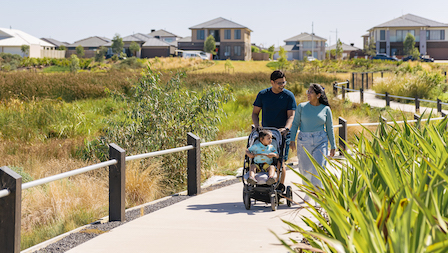
Among the best suburbs of Melbourne, Australia is Mambourin. This new, masterplanned suburb features wide streets, newer homes, landscaped parks, wetlands, and walking and cycling trails. Located in Melbourne's expanding outer south-west, it’s becoming a popular option for young families seeking modern community living.
- Median house price: ~$655,000
- Recent annual house price growth: 6.4%
- Rental yield: 3.9%
- Distance to CBD: ~36km from Melbourne
- Key appeal: Newer housing, green open spaces, and access to Melbourne’s western growth corridor
2. Clyde North, VIC
Clyde North is a growing suburb with schools, local shopping centres, playgrounds, and residential communities that appeal to young families. Green, spacious, and with a lifestyle that supports family and the outdoors, the suburb offers access to established centres such as Cranbourne and Berwick.
- Median house price: ~$750,000
- Recent annual house-price growth: 3.2%
- Rental yield: 4.3%
- Distance to CBD: ~50km from Melbourne
- Key appeal: Family-oriented amenities, growing infrastructure, access to Melbourne’s south-east

3. Shalvey, NSW
Adding to our list of best suburbs to invest in NSW is Shalvey. Predominantly residential, the suburb offers a practical, established suburban lifestyle, with access to services and transport connections across the wider Blacktown area.
- Median house price: ~$920,000
- Recent annual house price growth: 7%
- Rental yield: 3.8%
- Key appeal: Lower entry point than many Sydney suburbs, established services, strong recent price growth
4. Airds, NSW
Adding to our list of Sydney’s most in-demand suburbs is Airds, a leafy suburb with a lower entry price than most suburbs in Southwest Sydney. Family and community-oriented, the suburb offers space, local parks and access to Campbelltown's amenities.
- Median house price: ~$930,000
- Recent annual house-price growth: 13.2%
- Rental yield: 4%
- Key appeal: Access to Campbelltown's established services, family appeal, strong recent price growth
5. Caboolture, QLD
Caboolture offers a semi-rural vibe. Relaxed, spacious, with access to Moreton Bay, the suburb provides access to many established retail, schools, services and transport.
- Median house price: ~$910,000
- Recent annual house-price growth: 15.2%
- Rental yield: 4.1%
- Key appeal: Established infrastructure, access to Brisbane’s northern growth corridor, strong recent price growth
6. Woodridge, QLD
Woodridge is an established suburb, featuring a mix of older housing, shops, community facilities and green spaces. Convenient and practical, it’s good for people who prioritise convenience.
- Median house price: ~$850,000
- Recent annual house-price growth: 20.6%
- Rental yield: 4%
- Key appeal: Relatively accessible pricing, established services, strong recent market momentum
7. Armadale, WA
Armadale in Perth’s south-east offers established suburban convenience set against a green, hilly backdrop, making it appealing to buyers who like living near hills, parks and trails.
- Median house price: ~$715,000
- Recent annual house-price growth: 20.2%
- Rental yield: 4.9%
- Key appeal: Lower entry price, established amenities, strong recent growth and rental returns
8. Baldivis, WA
Baldivis is new, spacious and semi-rural. Expect rolling land in parts, wetlands, retained tuart trees, parks, sporting facilities, and newer homes, giving it a strong family and outdoorsy feel.
- Median house price: ~$850,000
- Recent annual house-price growth: 17.2%
- Rental yield: 4.3%
- Key appeal: Family-friendly amenities, access to Perth, strong recent price growth
Outer suburbs vs. inner-city: Where is affordability better?

It depends on what you value. Outer suburbs give you a lower entry price and more space for the same money. Inner-city locations give a higher entry price, but lower daily expenses due to proximity to essentials. To get the best of both worlds, consider self-sufficient, masterplanned communities in the outer suburbs.
Considerations when buying in very low-cost suburbs
A low purchase price doesn’t always mean lower overall housing costs. Transport, services, housing supply, and local employment can affect your day-to-day costs and the suburb's long-term appeal.
Here are three factors to consider:
- Expensive commutes: The money you save on your monthly mortgage can be swallowed up by toll roads, heavy petrol bills, or constant car maintenance if public transport isn't an option.
- Economic isolation: If a suburb lacks its own local job market or commercial precinct, its economy is dependent on the nearest major city centre. If that centre experiences a downturn, isolated outer pockets are the first to lose value.
- Housing Oversupply: Surrounding vacant land can lead to ongoing new housing releases that may increase local supply and moderate your property capital growth.
What to consider before buying in an affordable suburb

Finding the right affordable suburb is about choosing a place with the infrastructure to protect your lifestyle and your investment. To make sure you’re getting real value, keep these three things in mind:
- Walkable essentials: Check if you can easily walk or take a quick drive to your local supermarket, a medical clinic and childcare. If you have to hop on the highway just to grab milk or pick up a prescription, that "affordable" suburb might end up costing you more in time and petrol than you expected.
- Masterplanned community: Masterplanned communities are the "smart" choice for first-time buyers. They include parks, shopping strips and transport links in their blueprint from day 1. This is designed to maintain neighbourhood appeal and support sustained demand, which can help support long-term property values.
- Lifestyle perks: Look for those "quality of life" boosters like leafy parklands, safe walking trails, or even a decent local cafe. These things turn a collection of houses into a genuine community, making your home a place you’ll actually want to come back to at the end of the day.
Final thoughts

The eight suburbs featured here offer different combinations of price, recent market performance, infrastructure and lifestyle appeal.
Finding the right one for you means balancing the upfront purchase price with transport, services, employment, housing supply and the features that make a community suitable for your lifestyle. You can make this easier by focusing your search on pre-planned neighbourhoods where these amenities are carefully mapped out, helping you find a property designed to support your lifestyle and long-term financial goals.
Discover thoughtfully designed neighbourhoods in Australia's thriving growth pockets with Frasers Property.
Disclaimer: The information contained in this article is provided by Frasers Property Australia in good faith and is believed to be accurate at the time of publication. This content is of a general nature only and does not take into account your personal objectives, financial or taxation situation, or needs. It does not constitute financial, taxation, legal or other professional advice and should not be relied upon as such.
Any opinions, estimates, forecasts, statistics or conclusions are indicative only, may change over time and are based on publicly available information and third party sources. Frasers Property Australia makes no representation or warranty, express or implied, as to the accuracy, completeness or currency of information obtained from external sources or linked websites.
Information relating to grants, schemes and other costs is provided for general guidance only and may be subject to change. Before acting on any information contained in this webpage, you should consider its appropriateness for your circumstances and seek independent professional advice where necessary.


